


For several decades, VIA Rail Canada Inc. (VIA Rail), a Crown corporation created in 1977, has had limited ability to improve service because most of its trains operate on tracks shared with freight trains. VIA Rail relies heavily on funding from the Government of Canada to finance its operations. Since its creation, it has never achieved financial independence or profitability.
On 19 February 2025, the federal government announced the launch of a high-speed rail (HSR) project between Québec City and Toronto, with planned stops in Québec City, Trois-Rivières, Laval, Montréal, Ottawa, Peterborough and Toronto. The HSR project will run on approximately 1,000 kilometres of electrified track dedicated primarily to passenger service. The project will also have to meet various regulatory requirements relating to the environment, safety and accessibility, among other matters, and will be developed in consultation with communities and Indigenous peoples.
The HSR project will be built as a public–private partnership between Alto, a Crown corporation initially created under the name VIA HFR – VIA TGF Inc. in 2022, and the Cadence consortium, which was selected as the private partner in February 2025. The project is currently in the development phase, although several aspects of the project, such as the final alignment, departure frequency, cost and timeframe for entry into service, should be known by the end of this phase. That said, in December 2025, the federal government announced that construction of the Montréal–Ottawa segment is expected to begin in 2029.
Canada does not currently have any HSR lines, but they have grown in popularity in recent decades, particularly in Europe and Asia. HSR is more expensive to build than conventional rail since this type of railway requires additional infrastructure designed to support high peak speeds of around 300 kilometres per hour. Alto has indicated that “preliminary working assumptions” suggest construction costs of between $60 billion and $90 billion. The cost estimate will be refined gradually as expenditures for land acquisition, support infrastructure and rail structure become more specific.
For the HSR project between Québec City and Toronto to be financially self‑sustaining, travellers in the corridor will need to adopt HSR for their intercity travel. Alto argues that with the HSR, annual travel demand could reach 24 million intercity trips in the corridor by 2055 and up to 43 million by 2084, significantly more than the annual average of 4.5 million for the entire VIA Rail network in its 48 years of operation.
Since its founding in 1977, the Crown corporation VIA Rail Canada Inc. (VIA Rail) has been providing passenger rail service on various routes across Canada. Its busiest corridor is between Québec City and Windsor.1 VIA Rail has struggled for decades to maintain ridership on its network, and its on-time performance (OTP) is regularly criticized in the media. Since VIA Rail operates most of its trains on tracks shared with freight trains, congestion and delays are frequent, limiting its ability to increase and improve its services.
To address these challenges and overcome the constraints of its current operating environment in its busiest corridor, in 2016, VIA Rail proposed to the Government of Canada a high-frequency rail (HFR) project between Québec City and Toronto that would be built on dedicated tracks.2 However, on 19 February 2025, the Government of Canada announced its decision to opt instead for high-speed rail (HSR).3
This HillStudy first discusses VIA Rail’s mandate and analyzes its performance based on selected criteria. It then briefly describes the HSR initiative between Québec City and Toronto based on information available at the time of writing.
VIA Rail was established through an order in council but has no standalone enabling legislation that explicitly defines its mandate, governance powers or responsibilities.5 There are, however, by-laws (established under the Canada Transportation Act) that provide VIA Rail with rules for ticket requirements and passenger conduct, among other related matters.6
The corporation is designated as a parent Crown corporation in Schedule III, Part I, of the Financial Administration Act. As such, VIA Rail has limited operating autonomy and borrowing authority;7 it depends on annual parliamentary appropriations to offset any operating deficit incurred in providing federally mandated passenger rail service. No specific federal provisions or commitments assure stable and predictable annual funding.
Despite the lack of a standalone legislative mandate, VIA Rail is obligated to provide Canadians with year-round passenger rail service to both large and small communities. It does this through three main services:
VIA Rail’s income is derived principally from two sources: passenger rail revenues from ticket sales and parliamentary appropriations. Due to its dependence on the latter, VIA Rail’s operations are influenced by government policy decisions in addition to commercial considerations.
Table 1 and Table 2 below show selected key financial indicators and operating statistics that can be used to analyze VIA Rail’s performance between 2019 and 2024. This analysis reveals the following trends:
Notwithstanding the notable fluctuations associated with the pandemic years, Table 1 also shows that, over the six-year period from 2019 to 2024, revenues and expenditures remained relatively stable. The key exception to this was the increase in various operating expenses for 2023, such as on-train product costs, professional services, technical services, depreciation and amortization, and losses on disposal of property, plant and equipment, and intangible assets. These four areas alone accounted for $33.5 million of the $120.7 million increase in total expenses from the previous year (2022).
| Financial Indicators | 2024 | 2023 | 2022 | 2021 | 2020 | 2019 |
|---|---|---|---|---|---|---|
| Revenues – Passengers | 452,735 | 409,647 | 316,994 | 118,173 | 76,662 | 387,443 |
| Revenues – Other | 25,248 | 22,283 | 17,166 | 15,283 | 15,976 | 23,031 |
| Total revenues | 477,983 | 431,930 | 334,160 | 133,456 | 92,638 | 410,474 |
| Expenses – Compensation and employee benefits | 394,415 | 367,953 | 339,490 | 273,347 | 281,917 | 340,801 |
| Expenses – Train operations and fuel | 194,651 | 181,534 | 162,043 | 90,274 | 69,918 | 149,842 |
| Expenses – Stations and property | 50,905 | 47,819 | 41,079 | 42,248 | 39,409 | 39,159 |
| Expenses – Other | 374,174 | 346,816 | 280,778 | 219,098 | 254,386 | 289,995 |
| Total expenses | 1,014,145 | 944,122 | 823,390 | 624,967 | 645,630 | 819,797 |
| Total Expenses as a percentage of Total Revenues | 212% | 219% | 246% | 468% | 697% | 200% |
| Operating loss before funding from the Government of Canada and income taxes | (536,162) | (512,192) | (489,230) | (491,511) | (552,992) | (409,323) |
| Operating funding from the Government of Canada | 385,235 | 381,791 | 354,307 | 370,521 | 415,834 | 280,743 |
| Net income (net loss) | 52 | (9,055) | (15,241) | (26,289) | (15,969) | (10,889) |
Sources: Table prepared by the Library of Parliament based on data obtained from VIA Rail Canada Inc., 2024 Annual Report  (9.19 MB, 148 pages), pp. 81–82; and VIA Rail Canada Inc., “Annual reports ” (2019–2023), View reports of our activities and services.
| Operating Statistics | 2024 | 2023 | 2022 | 2021 | 2020 | 2019 |
|---|---|---|---|---|---|---|
| Total passenger miles (in millions) | 967 | 910 | 749 | 327 | 227 | 1,055 |
| Total passengers (thousands) | 4,389 | 4,117 | 3,302 | 1,512 | 1,147 | 5,008 |
| On-time performance (%) | 51 | 59 | 57 | 72 | 71 | 68 |
Sources: Table prepared by the Library of Parliament based on data obtained from VIA Rail Canada Inc., 2024 Annual Report (9.19 MB, 148 pages), p. 30; and VIA Rail Canada Inc., Annual Report 2019 (5.70 MB, 142 pages), p. 8.
Table 2 shows that during the pandemic years of 2020 and 2021, VIA Rail’s OTP increased before declining to a six-year low in 2024. Its average on-time performance between 2019 and 2024 was 63%, compared to 80% between 2006 and 2010.11
Historically, VIA Rail has struggled to improve its OTP. This issue has received frequent media coverage over the years and has been studied by both the Office of the Auditor General and the House of Commons Standing Committee on Transport.12
As VIA Rail owns only 3% of the rail networks it uses on a daily basis, it must negotiate contracts known as Train Service Agreements with the networks’ owners (i.e., the Canadian National Railway Company (CN), the Canadian Pacific Kansas City Limited, and other short-line carriers) for access to, and use of, the rail infrastructure.13 Consequently, VIA Rail’s operational performance hinges, in large part, on the terms of those contracts, and it has a limited ability to establish service schedules that would best serve its passengers.
Given that VIA Rail is mandated by the federal government to provide passenger rail service, and in light of its current operating cost structure, the Crown corporation is reliant on federal subsidies to meet its public-service obligations. Table 1 shows that this funding grew from almost $281 million in 2019 to around $385 million in 2024. Over its 48 years of operations, VIA Rail has not achieved financial self‑sufficiency or profitability.
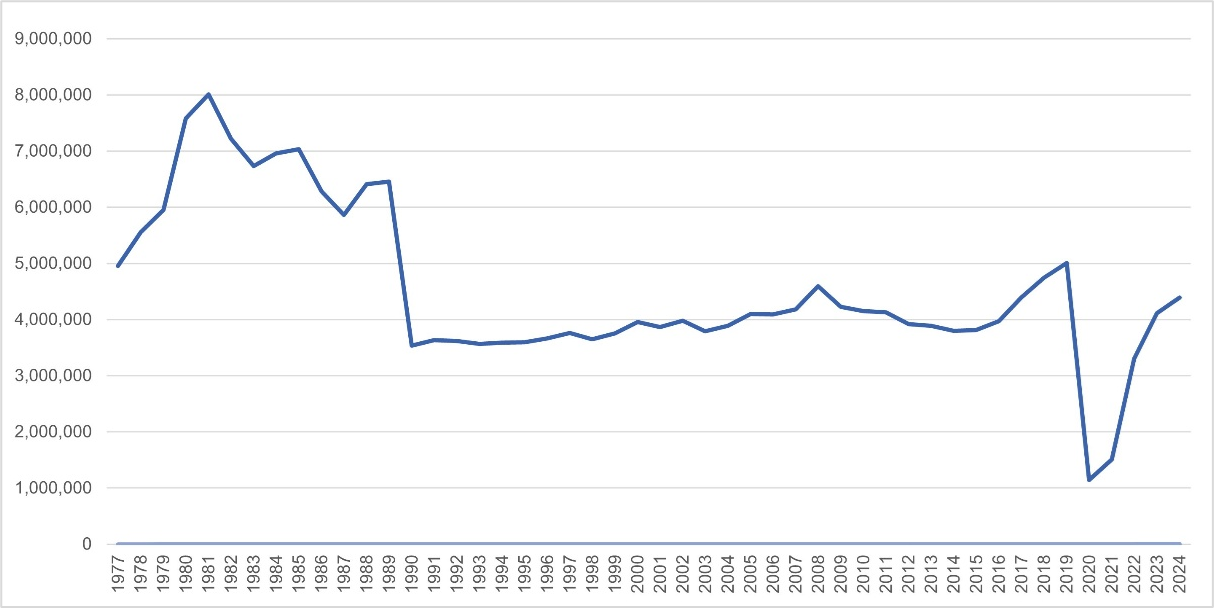
Figure 1 below shows that VIA Rail experienced strong growth in ridership throughout its early years, recording close to 5 million passengers in its first year (1977) and peaking at around 8 million passengers in 1981. Ridership then declined overall as VIA Rail abandoned some popular but nevertheless heavily subsidized, such as the service between Calgary and Edmonton, which was cancelled in 1985.14
During most of the 1980s, annual ridership fluctuated between approximately 6 million and 7 million passengers. In 1989, the federal government instructed VIA Rail to reduce operating costs and increase revenues so that it would be less dependent on subsidies. In response, it reduced its workforce and further cut services on certain routes. In 1989–1990, these cuts resulted in a loss of over 45% of VIA Rail’s ridership as many lines were dropped and it focused instead on routes with greater potential to increase ridership and revenues.15
As Figure 1 shows, VIA Rail’s average ridership between 1990 and 2016 was about 3.9 million annual passengers with little variance. Starting in 2017, ridership began to grow noticeably, reaching just over 5 million in 2019. This was due in part to passengers celebrating Canada 150, which created strong demand for the Canada 150 Youth Pass.16
As previously noted, ridership suffered a severe drop-off during the pandemic years, but it began to recover from its low point starting in 2021 and rebounded to 4.4 million annual passengers by 2024. This is very close to the average annual ridership of 4.5 million over the 48-year span of VIA Rail’s existence.
Figure 1 - VIA Rail Canada Inc.’s Annual Ridership, 1977–2024
Sources: Figure prepared by the Library of Parliament based on data obtained from VIA Rail Canada Inc., 2024 Annual Report (9.19 MB, 148 pages); VIA Rail Canada Inc., “Annual reports,” View reports of our activities and services; and Jean Dupuis, VIA Rail Canada Inc. and the Future of Passenger Rail in Canada, Publication no. 2015-55-E, Library of Parliament, 31 August 2015.
In 2016, VIA Rail presented the Government of Canada with a proposed HFR project for its busiest corridor, the Québec City–Windsor corridor. VIA Rail argued that the use of dedicated tracks would enable “faster, safer, more frequent, more accessible, and more reliable service to Canadians.” 17 After assessing the proposal, the Government of Canada announced in July 2021 that it was beginning the procurement process for the creation of a new rail service between Québec City and Toronto.18
In March 2022, the Government of Canada issued a Request for Expressions of Interest (RFEOI) to gather advice and guidance from experienced private-sector companies on the project.19 An update to the RFEOI was issued in October 2022,20 in anticipation of the launch of the Request for Qualifications (RFQ) in February 2023.21 The purpose of the RFQ was to identify up to three potential private-sector candidates to submit bids as partners.
These candidates were then asked to submit two solutions with respect to speed: one that would allow trains to travel at 200 kilometres per hour (km/h) and another that would include high-speed segments.22 In February 2025, the government announced that it had selected the proposal submitted by the Cadence group, a consortium comprising transport service providers Air Canada, SNCF Voyageurs, and Keolis, engineering firms SYSTRA and AtkinsRéalis, and CDPQ Infra, a subsidiary of the Caisse de dépôt et de placement du Québec specializing in public infrastructure development.23 The project would be a high-speed train capable of reaching speeds of 300 km/h.
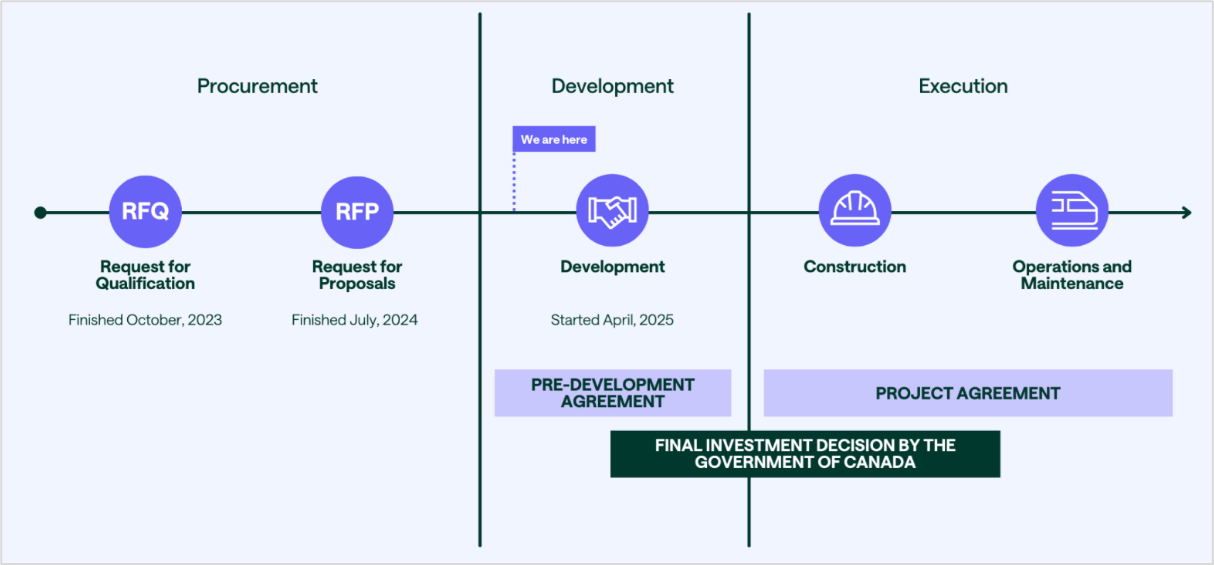
The Government of Canada also stated that it would invest $3.9 billion over six years for the development phase, starting in the 2024–2025 fiscal year. This investment is on top of the $371.8 million announced in budget 2024.24 The development phase includes the technical design of the project, consultation with affected communities, including Indigenous communities, and the impact assessment process. This phase is expected to last around five years, followed by construction, which will be carried out in segments based on the alignment selected. Each segment will take between five and seven years to build.25 Figure 2 shows the project phases.
Figure 2 - Phases of the High-Speed Rail Project Between Québec City and Toronto
Source: Alto, What’s Happening.
In March 2022, the Government of Canada adopted orders in council authorizing the creation of VIA HFR – VIA TGF Inc. (VIA HFR), a wholly owned subsidiary of VIA Rail with a mandate to develop and implement HFR “through one or more agreements with the private sector, in cooperation with the Minister of Transport.” 26 VIA HFR was incorporated in November 2022 under the Canada Business Corporations Act.27 In February 2025, VIA HFR’s name was changed to “Alto.” Reporting to Parliament through the Minister of Transportation, Alto is headed by a president and CEO and governed by a board of directors. This change coincided with the Government of Canada beginning to refer to the project as “high-speed rail” rather than using “high-frequency rail” as it had been doing just months before.28 Alto is both the name of the HSR project and the Crown corporation responsible for it.
With the development phase underway, several aspects of the HSR project, such as the final alignment, departure frequency, cost and timeline for operation, remain to be confirmed.
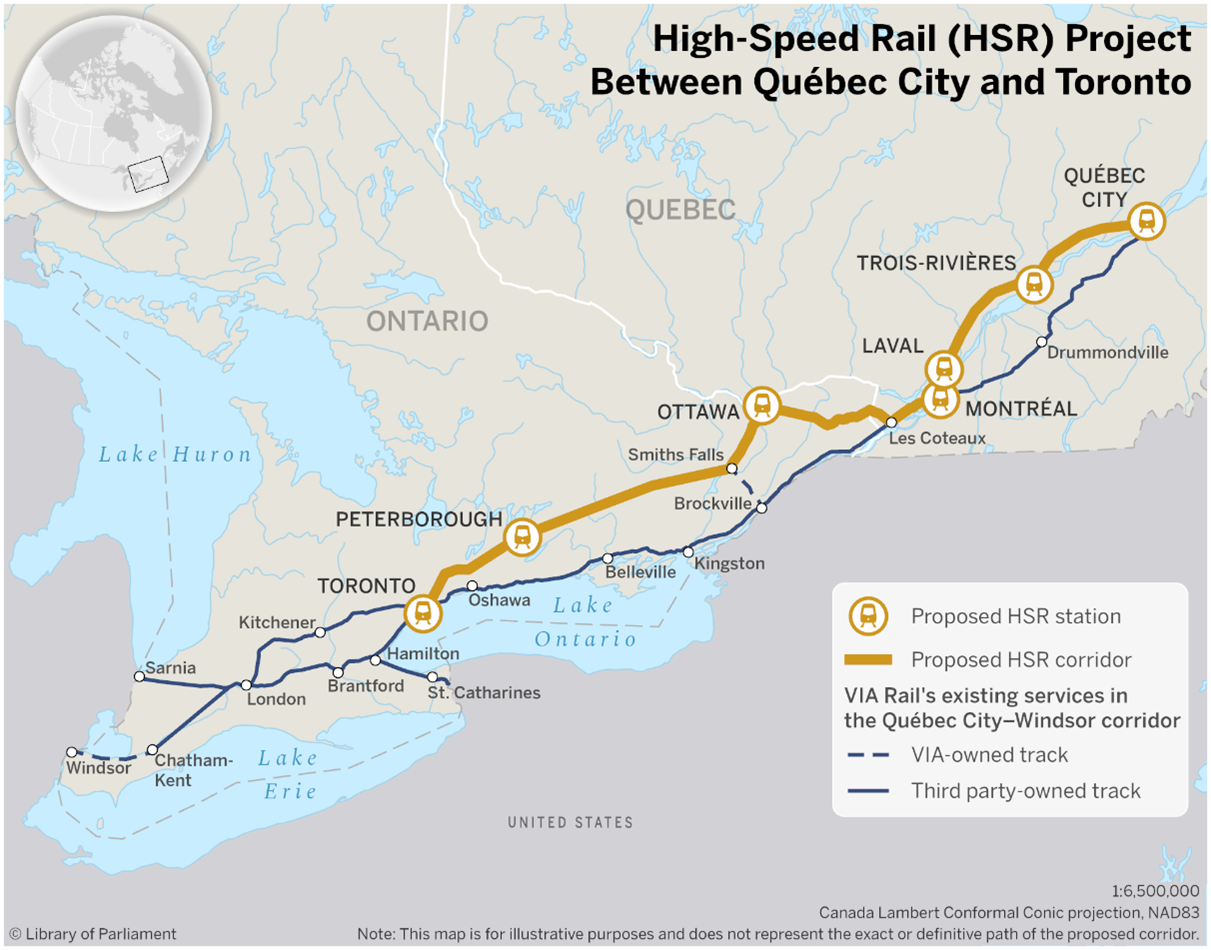
According to the October 2022 update to the RFEOI, the Government of Canada was considering nearly 1,000 km of “mostly electrified rail service that uses mostly dedicated tracks between Québec City, Trois-Rivières, Montréal, Ottawa, Peterborough and Toronto.” 29 Since then, Alto has indicated that Laval will also be included in the project.30 For the time being, the alignment and the location of the stations are not known and will be determined during the development phase. That said, Alto’s 2024–2025 to 2028–2029 corporate plan states that the project will have to provide “greater intermodal connectivity” in major cities, suggesting that the chosen alignment will focus on connections with local public transit systems.31 Although the goal is to prioritize the use of dedicated tracks, Alto specified in its corporate plan, at a time when it was still referring to HFR, that the train would run on tracks owned by railways such as CN and Metrolinx, particularly in urban centres. This approach would require negotiating access agreements with these railways.32 It is worth noting that should the alignment use both existing and new segments of track, these older segments, which were designed for standard speeds, could in theory limit peak speeds compared to the new segments, which were designed for higher speeds.33
Figure 3 shows the potential alignment of the new HSR project between Québec City and Toronto, as well as the alignment of VIA Rail’s existing services in the Québec City–Windsor Corridor. Alto confirms that existing services will be “optimized and integrated within the expanded intercity passenger rail operations.” 34
Figure 3 - Proposed Alignment of High-Speed Rail Between Québec City and Toronto
Sources: Map prepared by the Library of Parliament, 2025, using data obtained from Alto, Frequently Asked Questions (FAQs); Natural Resources Canada (NRCan), National Railway Network – NRWN – GeoBase Series; NRCan, Administrative Boundaries in Canada – CanVec Series – Administrative Features, 1:5M, 2019; NRCan, Lakes, Rivers and Glaciers in Canada – CanVec Series – Hydrographic Features, 1:5M, 2019; and NRCan, Wooded Areas, Saturated Soils and Landscape in Canada – CanVec Series – Land Features, 1:5M, 2019. The following software was used: Esri, ArcGIS Pro, version 3.4.0. Contains information licensed under the Open Government Licence – Canada.
The project, which requires land acquisition and the construction of a new railway, will also have to comply with various regulatory requirements, including environmental, safety and other requirements.35 As specified in Alto’s 2024–2025 to 2028–2029 corporate plan, the project is subject to the Impact Assessment Act.36 Essentially, the impact assessment process involves reviewing the positive and negative impacts of a proposed project, including with respect to the environment, the economy and the rights of Indigenous peoples. In 2024, Alto began conducting field studies on the environmental impact of building an HSR line in the Québec City–Toronto corridor. These studies cover potential impacts on various animal species, noise and vibration, and water and air quality.37
In December 2025, the federal government and Alto announced that Ottawa–Montréal would be the first segment to be built, starting in 2029.38 Alto estimates that it will take only an hour to travel between the two cities, which is half as long as the journey currently takes on VIA Rail. In January 2026, a proposed corridor approximately 10 km wide was unveiled ahead of public consultations with affected communities.39 Alto stated that the consultations will help it define the alignment, which will be the subject of a second round of consultations in the fall of 2026.40 The final alignment is expected to occupy a corridor 40 to 60 metres wide.41
In 2023, VIA HFR held consultations with Indigenous communities that might be affected by the HFR project. Roughly 90% of the communities affected by the potential alignment had an opportunity to present recommendations on the project. The consultations were summarized in a report entitled “What We Heard and What We Are Doing.” 42
In November 2025, the federal government tabled Bill C-15, An Act to implement certain provisions of the budget tabled in Parliament on November 4, 2025.43 Division 1 of Part 5 of Bill C-15 enacts the High-Speed Rail Network Act. This Act contains a declaration that the project falls under federal jurisdiction. It also states that each segment of the corridor will be subject to an impact assessment and that certain lands will be subject to a notice of right of first refusal or a notice of prohibition on work.44 In addition, Bill C-15 amends certain processes set out in the Expropriation Act to accelerate the process for expropriating land for the HSR project. For example, the requirement to hold a public hearing in the event of objections to an expropriation under the Expropriation Act will not apply. Individuals will be able to object in writing.
Indigenous peoples are especially affected by certain provisions of the High-Speed Rail Network Act, particularly sections 17 to 23, which relate to expropriation rights and do not mention rights specific to Indigenous peoples, and section 25, which relates to the confidentiality of the Indigenous knowledge gathered as part of the project.45
In December 2025, the Standing Senate Committee on Transport and Communications undertook a study of certain elements of Bill C-15, including Division 1 of Part 5. During the study, Chief Francis Verreault-Paul of the Assembly of First Nations Quebec–Labrador, and Abram Benedict, the Ontario Regional Chief of the Assembly of First Nations, had an opportunity to speak on the HSR project.46
Both witnesses t suggested that Bill C-15 had been rushed without sufficient consultations of the First Nations affected by the project. They also stated that the expropriation powers set out in the new act disregard the land rights of the affected Indigenous peoples. Both chiefs called for the bill to be amended to fix these problems.47
The witnesses also expressed strong reservations about section 25 of the High-Speed Rail Network Act, the first paragraph of which reads as follows:
Any Indigenous knowledge that is provided to the Minister, the appropriate Minister or the [Alto] Corporation in relation to the high‑speed rail network in confidence is confidential and must not knowingly be, or be permitted to be, disclosed without written consent.
The witnesses argued that this type of information, which could include knowledge about plants, hunting or ceremonial grounds, should remain under the exclusive ownership of Indigenous peoples so that it does not end up in the wrong hands.48
As previously mentioned, the rail project between Québec City and Toronto was changed from HFR to HSR. Maglev, a type of magnetic levitation train that reaches maximum speeds of 600 km/h, is a transportation technology that was not selected for the project. HFR, MSR and maglev systems have different characteristics, including speed, equipment and cost.
In the context of the projected rail corridor between Québec City and Toronto, HFR refers to a type of rail transport with a top speed of no more than 200 km/h.49 Building this type of rail line involves combining new tracks with existing ones.
The term “HFR” is not commonly used outside Canada, but this type of railway line refers to conventional rail. The term was used by the federal government to emphasize train frequency in the project to build dedicated passenger rail tracks. In its March 2025 report entitled Fast Forward: Shaping Canada’s Future with a High‑Speed Rail Network, Alto proposes building HSR rather than “conventional rail”; HFR is not mentioned in the document.50
HSR generally refers to railway lines where trains reach a maximum speed of at least 200 km/h. Some trains on commercial lines in China can reach 350 km/h.51 Building HSR lines requires adding special new tracks that in most cases are reserved for these trains. However, the technology used by HSR allows for interoperability with existing conventional rail lines and stations. This interoperability supports the development of HSR networks by using existing infrastructure such as tracks and stations, which are often already integrated into the urban landscape. HSR is more expensive to build than conventional rail since it requires additional infrastructure to accommodate trains that reach higher maximum speeds.52
The world’s first HSR line opened in Japan in 1964. Since then, HSR has gained in popularity around the world, mainly in Europe and Asia.53 Although China has the world’s largest HSR network, projects are underway or planned in several countries, such as Brazil, India, Australia and Canada.54
The Asia-Pacific region, in particular China, South Korea and Japan, has experienced the largest boom in HSR and maglev construction projects.55 In 2023, Asia had the most extensive HSR network, with roughly 75% of the world’s high‑speed lines.56 Europe is the second-largest market for building and operating HSR lines.57 Although HSR technology was first introduced in the 1960s, technological development and network expansion rapidly took off from 2008 onwards with the launch of major projects in China. Between 2008 and 2021, the commercial HSR network in service worldwide grew from 11,724 km to 58,839 km.58 In 2023, China alone operated a network of 45,390 km. Lastly, among the new networks built in recent years, Morocco opened its first HSR line, linking Tangier and Kenitra at the end of 2018.59
Maglev lines are being built and operated mainly in Japan, China and South Korea. The Shanghai Transrapid Maglev, which began operating in 2004, is one example. It connects Shanghai Pudong International Airport to the Pudong District of Shanghai, a distance of about 30.5 km. This maglev train reaches a maximum speed of 431 km/h and can take passengers from the airport to the city in eight minutes.60 Other Maglev construction projects have been less successful. For example, Germany, which invested in maglev train projects in the early 2000s, has backtracked due to technical challenges and the considerable cost of building this type of rail network compared to HSR construction.61
In a document presenting the HSR project between Toronto and Québec City, Alto stated that “current preliminary working assumptions [of the cost] range between $60B and $90B.” Alto added that the HSR system will be financially self-sustaining since “the project’s revenues from increased ridership of up to 43 million passengers per year by 2084 are expected to cover ongoing operations and maintenance costs.” 62 According to Alto, the projected annual ridership of 24 million by 2055 and 43 million by 2084 is “based on internationally recognized models used in several high-speed rail systems around the world.”63 A study published by Transportation Research at McGill University estimated however that the ridership could reach approximately 10 million by 2050.64
Building a new HSR system incurs various costs. It requires funding for planning (development phase) and for acquiring land. Further, construction of the supporting infrastructure, such as tunnels and viaducts, calls for significant levels of investment. Lastly, the costs of the rail structure itself, such as tracks, signalling/communication systems and stations, must be covered.65 In its project presentation document, Alto explained that “the [HSR] project will support up to 51,000 jobs over 10 years.” 66 Alto also stated that the project “will [offer] opportunities to gain expertise and develop specialized skills in the rail sector – an area currently lacking in specialized knowledge.” 67
The topography of the terrain and the availability of land are key factors in determining construction costs. An alignment through densely populated areas increases not only the cost of land, but also the need to build additional infrastructure such as viaducts and tunnels.68
When announcing the HFR project, the Government of Canada stated that it would be delivered as a public–private partnership (commonly known as “P3”). P3s take a long-term, performance-based approach to procuring public infrastructure. Under this model, responsibility for various elements of the project – from design and planning to long-term maintenance – is transferred to the private sector, which thereby provides a significant share of the project’s financing and assumes an equivalent share of the risks.69
The type of P3 chosen or developed is generally based on an analysis to determine which one “would deliver the desired asset at the lowest cost when all factors, including asset life, risk and the time value of money, are considered.” 70
The Government of Canada chose a “progressive” P3 model for the project (initially HFR).71 This type of partnership involves “[integrating] private sector expertise early in the procurement process, before the government has chosen a delivery model.” 72 The federal government based its decision on the following rationale:
Infrastructure projects the size, scale and complexity of HFR call for Public-Private-Partnership (P3) methods that are above and beyond the traditional, fixed-price, fixed-schedule design. As a result, the Government of Canada chose to proceed with an innovative P3 model for the HFR project. This type of integrated delivery model, with early private sector involvement in all aspects of this major project, can produce better outcomes by boosting innovation and collaboration between the public and private sectors. This approach is expected to lead to better project results and provide the best value for Canadians.73
A 2024 report of the Canadian Council for Public-Private Partnerships, entitled Modernizing Canada’s Approach to Public-Private Partnerships (P3s) makes a number of recommendations that are relevant to current discussions surrounding the proposed HSR initiative in Canada, including the following:
- Governments should investigate using a progressive P3 (DBFM/DBFOM) approach for exceptionally large or complex projects …
- Where possible, governments should consider breaking large projects (exceeding $500 million) into phases to attract greater competition, produce greater market tension and greater certainty in execution, and cost savings.74
Financial reporting in relation to P3s is critical since the public-sector partner is accountable to Parliament and Canadians for ensuring sound project administration and value-for-money. Because accounting for P3s is recognized as complex due to the scale of infrastructure projects, long-term risks and contract-specific terms – additional disclosures beyond standard public-sector accounting requirements may be necessary. For example, providing detailed information about the P3 structure, the quantification of significant risks and any instances of non-compliance would demonstrate the responsible management of public funds and clarify any fiscal exposures associated with the arrangement.75
A 2023 study of European HSR projects implemented via P3s showcased the following recommendations:
In 2019, the Accessible Canada Act (ACA) came into force with the goal of making Canada barrier-free in areas under federal jurisdiction, including transportation, no later than 1 January 2040. As a federal Crown corporation, Alto is subject to the ACA and is required to submit an accessibility plan (and subsequent plans) detailing how the corporation plans to identify, prevent and remove barriers in areas such as the built environment, the design and delivery of programs and services, and communications.78 Alto has released its first accessibility plan for 2025 to 2027.79
Under the Canada Transportation Act (CTA), modes of transportation under federal jurisdiction must be accessible without barriers to persons with disabilities.80 Railways that cross more than one province are under federal jurisdiction.81 The CTA and the ACA define a barrier as anything that prevents persons with disabilities from participating fully and equally in society, whether that barrier is physical or architectural in nature, related to information, communications, technology, behaviour, or is the result of policies and practices.82
In 2019, the Canadian Transportation Agency adopted the Accessible Transportation for Persons with Disabilities Regulations, pursuant to the CTA. The regulations apply to certain transportation service providers, such as VIA Rail and Amtrak, and to terminals in modes of transportation under federal jurisdiction.83 The regulations include several provisions regarding the travel experience, including services, communications, facilities and employee training.84 Although Alto is not subject to the regulations because it “is not currently a transportation carrier or provider,”85 the corporation did provide the following clarification in its accessibility plan for 2025–2027:
[W]e will consider these regulations, as well as future regulations, best practices and guidance as we continue to strive to meet or exceed accessibility standards in the design and operation of the future passenger rail project.86
As stated on Alto’s website, the HSR project between Québec City and Toronto aims to achieve the following results:
In its project presentation document, Alto estimates that 18 million people, or approximately 50% of Canada’s population, live in the Québec City–Toronto corridor and that the population in the corridor will grow by 30% by 2041.88 The current use of tracks shared with freight trains limits VIA Rail’s ability to expand and improve its services to meet growth in future demand. According to Alto, the HSR project, would increase the annual demand for intercity trips in the corridor to 24 million by 2055 and up to 43 million by 2084.89
In addition, the arrival of HSR could lead to a modal shift for travellers in the corridor, who would opt for HSR instead of road or air transportation. For example, for the Montréal–Toronto segment, Alto estimates that currently 55% of travellers choose cars, 32% choose planes, 10% choose trains and 3% choose buses. An HSR service could capture up to 40% of passengers on this segment, reducing the share of cars to 39% and that of planes to 19%.90 This would help reduce road congestion and GHG emissions since the HSR service will run on electrified tracks. According to Alto, this modal shift would reduce GHG emissions by approximately “39 million tonnes over the project’s lifecycle.” The reduction in GHG emissions would support the Government of Canada’s 2030 Emissions Reduction Plan goal of net-zero emissions in Canada by 2050.91
Researchers have looked at the factors that influence modal shift and the criteria that travellers use to choose HSR over cars or planes for the same trip. Among the most important factors, in no particular order, are travel time, cost (affordability), frequency and reliability of service, comfort, safety and ease of access to stations.92 This last factor refers to the smoothness of the journey, in other words, how complicated it is to get to and from a station. The station’s connectivity to the local public transport network can play an important part in determining this.93 The relative importance of these factors depends on the circumstances of each traveller. For example, business travellers may be less influenced by price and more by the frequency and reliability of departures and arrivals. However, travellers with reduced mobility may place greater importance on train accessibility and ease of access to the station.
In VIA Rail’s early years, ridership reached nearly 8 million passengers, then stabilized at around 4 million between the late 1980s and the start of the COVID-19 pandemic. In 2024, 95% of passenger train trips were made in the Québec City–Windsor corridor. In February 2025, the Government of Canada announced the construction of an HSR line connecting Québec City, Trois-Rivières, Laval, Montréal, Ottawa, Peterborough and Toronto on electrified tracks dedicated primarily to passenger service. According to Alto, the project should generate annual demand for 24 million intercity trips in the corridor by 2055. In its announcement, the federal government maintains that in addition to reducing travel time in the corridor, the project would have economic and environmental benefits.
As the project enters its development phase, questions remain about station locations, track alignment, ticket prices, total cost, frequency of departures and the timeframe. In addition, the project will have to comply with a number of regulatory requirements, including those related to the environment, safety and accessibility. It will also involve engaging communities and Indigenous peoples with concerns about the track alignment.
(4.17 MB, 128 pages), pp. 14–15; and Transport Canada, Ongoing efforts for High Frequency Rail in the Toronto to Quebec City Corridor, Backgrounder. [ Return to text ] (312 KB, 21 pages). [ Return to text ] (1.45 MB, 71 pages), p. 3; and VIA Rail, “Who We Are,” 2024 Annual Report (9.19 MB, 148 pages), p. 3. [ Return to text ] (9.19 MB, 148 pages), p. 11. [ Return to text ] (1.45 MB, 71 pages), p. 3. [ Return to text ] (759 MB, 35 pages) 2016 Spring Reports of the Auditor General of Canada; and House of Commons, Standing Committee on Transport, The Renaissance of Passenger Rail in Canada, Fourth report, June 1998. [ Return to text ] (5.27 MB, 148 pages), p. 19; and Jean Dupuis, VIA Rail Canada Inc. and the Future of Passenger Rail in Canada, Publication no. 2015-55-E, Library of Parliament, 31 August 2015, p. 6. [ Return to text ] (5.83 MB, 132 pages), p. 6. [ Return to text ] (4.17 MB, 128 pages), p. 15. [ Return to text ] (2.80 MB, 73 pages), March 2022. [ Return to text ] (1.13 MB, 51 pages), October 2022. [ Return to text ] (5.14 MB, 430 pages), Budget 2024, p. 257. [ Return to text ]This status of agent of the Crown means that the Government of Canada is fully liable for all actions taken by the agent while it is operating under its mandate. Meanwhile, the agent enjoys the same constitutional immunities, privileges and prerogatives as the Crown.See Legislative Summary of Bill C-69: An Act to implement certain provisions of the budget tabled in Parliament on April 16, 2024, Publication no. 44-1-C69-E, Library of Parliament, 31 May 2024; and VIA HFR – VIA TGF Inc. (now Alto), Quarterly Financial Report: Period Ended December 31, 2024
(614 KB, 19 pages), p. 2. [ Return to text ] (1.13 MB, 51 pages), October 2022, p. 4. [ Return to text ] (2.02 MB, 87 pages), p. 34. [ Return to text ] (2.02 MB, 87 pages), p. 33. [ Return to text ] (4.28 MB, 56 pages), 2023, p. 48. [ Return to text ] (7.85 MB, 31 pages), March 2025, p. 20. [ Return to text ] (2.02 MB, 87 pages), pp. 14 and 18. [ Return to text ]includes mines, buildings, structures, other things in the nature of fixtures and objects that are immovable within the meaning of Quebec civil law and also includes minerals whether precious or base, on, above or below the surface, but excludes minerals above the surface in Quebec.See Expropriation Act, R.S.C. 1985, c. E-21, s. 2. [ Return to text ]
(7.85 MB, 31 pages), March 2025. [ Return to text ] (4.28 MB, 56 pages), 2023, pp. 6–8. [ Return to text ] (4.28 MB, 56 pages), 2023, p. 8. [ Return to text ] (136.65 MB, 208 pages), pp. 31 and 168. [ Return to text ] (7.85 MB, 31 pages), March 2025, p. 20. [ Return to text ] (670 KB, 13 pages) Transportation Research at McGill, McGill University, March 2026, p. 5. [ Return to text ] (1.21 MB, 36 pages), Discussion paper, May 2012, pp. 8–9. [ Return to text ] (7.85 MB, 31 pages), March 2025, p. 27. [ Return to text ] (1.21 MB, 36 pages), Discussion paper, May 2012, p. 9; John Preston, ITF, OECD, The Economics of Investment in High Speed Rail (1.16 MB, 40 pages), Discussion paper, December 2013, pp. 20–21; and Australia, Department of Infrastructure, Transport, Regional Development and Local Government, A profile of high-speed railways (1.12 MB, 20 pages), p. 5. [ Return to text ]after the public agency selects a partner based on qualifications (or possibly their fee structure) for the “collaborative” stage of the project, the developer is usually given “first rights” if the project advances sufficiently. Subsequently, project design, risk allocation, and pricing are developed jointly between the public and private sector for the purpose of creating an asset that is, ideally, more “fit-for-purpose,” after which parties enter into a comprehensive agreement.[ Return to text ]
(1.37 MB, 18 pages), August 2024, p. 12. [ Return to text ] (1.37 MB, 18 pages), August 2024. [ Return to text ] (1 MB, 15 pages). [ Return to text ] (1 MB, 15 pages), p. 15. [ Return to text ] (7.85 MB, 31 pages), March 2025, p. 7. [ Return to text ] (616 KB, 64 pages), Mineta Transportation Institute, June 2014; and Jing Yu Pan and Stefan Rooze, High-Speed Rail in the U.S. – Mode Choice Decision and Impact of COVID-19 (1.05 MB, 119 pages), Center for Advanced Transportation Mobility, September 2023. [ Return to text ]© Library of Parliament